

Used Construction Equipment Market Forecast: USD 243 Billion by 2035 Driven by Digital Platforms & Public Infrastructure
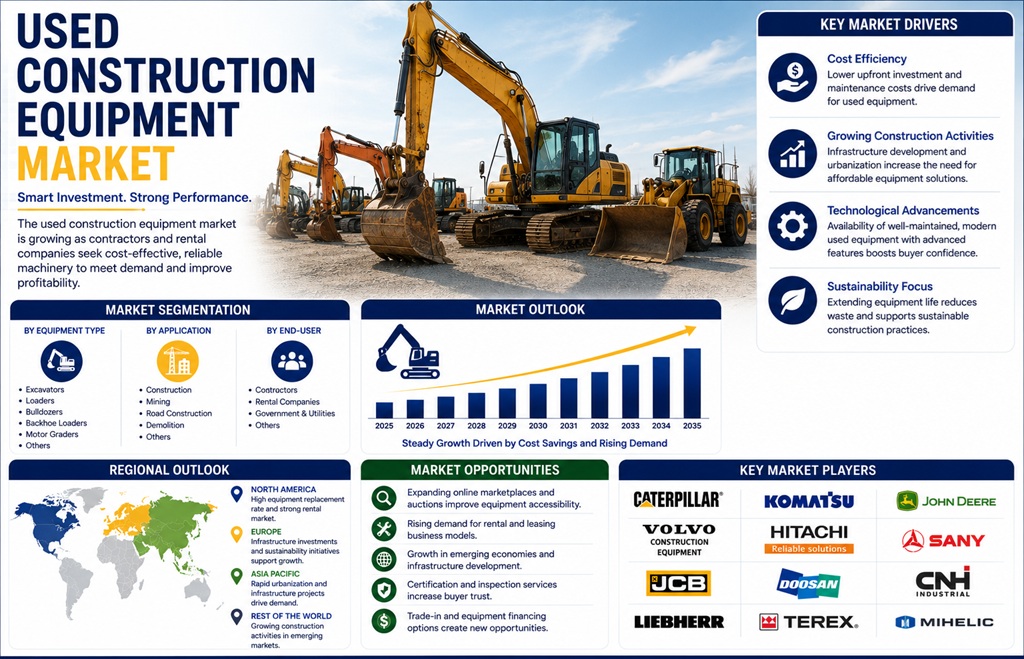
Used Construction Equipment Market (2026 - 2035)
North America remained the second-largest region, supported by federal highway and broadband infrastructure spending cycles.
CA, UNITED STATES, July 21, 2026 /EINPresswire.com/ -- According to a comprehensive report by Market Research Future (MRFR), the global used construction equipment market reached an estimated USD 134.40 billion in 2025 and is projected to grow from USD 142.60 billion in 2026 to USD 243.00 billion by 2035, registering a compound annual growth rate of 6.10%. This expansion is anchored in two structural forces: government infrastructure programs investing record amounts in roads, bridges, and transport systems, and new-equipment OEM delivery backlogs stretching 12–18 months in many categories, channeling contractors toward the secondary market as a core operational strategy rather than a stopgap solution.The Infrastructure Imperative: Public Spending as Demand Engine
The single most powerful driver of the used construction equipment market is sovereign infrastructure spending at a scale unseen in generations. The U.S. Bipartisan Infrastructure Law alone allots nearly USD 550 billion in new government expenditure through 2030, covering roads, bridges, broadband, water systems, and electric vehicle charging infrastructure. India's National Infrastructure Pipeline aims to award USD 1.4 trillion in projects between 2025 and 2030. China's 15th Five-Year Plan transport corridors continue to absorb massive equipment fleets. Brazil's Programa de Aceleração do Crescimento (PAC) earmarks BRL 1.7 trillion for roads, sanitation, and energy through 2030.
These programs create an urgent need for deployable equipment. Contractors source from the secondhand construction equipment market in order to meet groundbreaking dates because new equipment delivery windows frequently surpass project mobilization timetables. A contractor awarded a highway segment in 2025 cannot wait until 2027 for a new excavator to arrive from the factory. The used construction equipment market has become the operational backbone of infrastructure delivery, not merely a budget-conscious alternative.
Fleet operators across both mature and developing economies increasingly treat pre-owned units as core operational capacity rather than stopgap solutions, compressing traditional replacement cycles. This behavioral shift is structural: it reflects a permanent elevation in the strategic importance of secondary machinery within contractor fleet planning.
Download Report Sample Copy: https://www.marketresearchfuture.com/sample_request/28625
The OEM Backlog Effect: Scarcity as Market Catalyst
Semiconductor shortages and specialty-steel supply constraints continue to extend OEM lead times for hydraulic excavators, articulated dump trucks, and large wheel loaders to 9–18 months in several product categories. This backlog effect channels buyers toward the secondary market, where certified pre-owned programs from Caterpillar, Komatsu, and Volvo CE offer 12-month powertrain warranties that narrow the perceived risk gap between new and used assets.
The dynamic has structurally lifted used-unit pricing by 15–22% since 2021 in North America and Europe. Machines that once depreciated predictably now retain value at rates that challenge traditional residual-value models. A five-year-old excavator with verified telematics history and a clean maintenance record may command 80–85% of its original purchase price—a figure that would have been unimaginable a decade ago.
Certified pre-owned (CPO) programs are replicating the automotive model at scale. Caterpillar's Cat Certified Used program and Komatsu's Reman operations demonstrate early traction; expanding these to mid-tier brands represents a growth lever across the used construction equipment market. OEM-backed CPO units typically command 12–20% price premiums over comparable non-certified machines, reflecting warranty coverage and standardized multi-point inspections. The premium narrows for equipment older than 10 years, but the certification model itself is transforming buyer expectations.
The Digital Revolution: From Auction Yard to Global Marketplace
Perhaps the most transformative trend reshaping the used construction equipment market is the digitization of transactions. Online auction houses—Ritchie Bros., Euro Auctions, and emerging regional platforms—have increased the addressable buyer pool by facilitating cross-border transactions with standardized inspection reports. According to Ritchie Bros., bidders from more than 140 countries took part in individual sales events, and online-only transaction volumes increased by 38% between 2022 and 2024.
Coordination of logistics, integrated finance, and real-time multilingual bidding eliminate the friction that formerly divided the market along geographic lines. A contractor in Nairobi can now bid on a machine in Houston, secure financing through the platform, and arrange shipping—all within a single transaction flow that previously would have required months of relationship-building and broker intermediation.
By 2030, an estimated 45–50% of secondary-market transactions by value will occur through digital channels, up from approximately 28% in 2025. This shift is not merely about convenience; it is about price discovery, liquidity, and market efficiency. Digital platforms compress bid-ask spreads, reduce information asymmetry, and enable real-time benchmarking against comparable sales—transforming used construction equipment from an illiquid, relationship-driven asset class into a globally traded commodity.
AI-enabled condition grading and predictive valuation are accelerating this transformation. Machine-learning models trained on telematics data, visual-inspection imaging, and historical maintenance records enable automated condition grading that rivals expert assessors. Platforms deploying these tools can offer buyers guaranteed-condition scores with insurance backing, reducing the trust deficit that constrains private-party and cross-border transactions.
Purchase Now: https://www.marketresearchfuture.com/checkout?currency=one_user-USD&report_id=28625
Product and Segment Dynamics
Excavators accounted for 45.6% of the used construction equipment market in 2025, reflecting their versatility across residential, commercial, and infrastructure applications. Their modular attachment ecosystem—buckets, breakers, augers, grapples—makes a single used excavator adaptable across project types, sustaining strong resale demand even at high-hour counts.
Cranes are forecast to register the fastest segment CAGR of 6.88% through 2035, fueled by high-rise construction and wind-turbine installation demand. Onshore wind-farm installation programs in Europe, the U.S., and India require crawler and tower crane capacity on tight timelines that exceed OEM delivery capacity, channeling demand toward the secondary market.
Loaders generated USD 18.90 billion in 2025, serving material handling in quarries and logistics yards. Telescopic handlers are advancing at a 6.35% CAGR, driven by agricultural and warehouse applications. Others—including dozers, graders, and compactors—accounted for USD 22.15 billion, serving road construction and site preparation.
By drive type, internal combustion engine units represented the dominant category in 2025, reflecting the installed base reality of diesel-dominant fleets. Electric/hybrid powertrains are expanding at an 8.65% CAGR—the fastest drive-type growth rate—as emission-free jobsite mandates intensify and first-generation electric units enter resale channels.
By end-use industry, construction and infrastructure absorbed 62.6% of the market in 2025, reflecting the sector's scale and the diversity of machine types required across residential, commercial, and civil-works sites. Mining and quarrying is the fastest-growing end-use segment at a 5.85% CAGR, as commodity supercycles prompt mining operators to rapidly scale fleet capacity using used haul trucks, excavators, and dozers rather than waiting 12–18 months for new deliveries. Oil and gas generated USD 10.75 billion, while agriculture and forestry advanced at a 5.50% CAGR.
By sales channel, dealers and brokers remained the primary transaction channel with a 50.0% share in 2025, leveraging inspection infrastructure, reconditioning capabilities, and OEM-backed warranty programs to command premium pricing. Auction platforms recorded the highest sales-channel CAGR at 7.59%, as digital bidding environments bring price transparency and global buyer access. Direct/private-party sales generated USD 22.40 billion, while online marketplaces grew at a 7.10% CAGR.
Regional Dynamics: Asia-Pacific Dominates, All Regions Expand
Asia-Pacific commands roughly 51.0% of the used construction equipment market, the largest regional share, driven by rapid urbanization in India, Southeast Asia, and continued infrastructure buildout in China. The region also leads growth at a 7.14% CAGR through 2035. China alone contributes 38.2% of regional share, functioning as both the largest consuming and exporting market for used units, with domestic dealers shipping surplus inventory to Southeast Asian and African markets through bonded logistics hubs in Guangzhou and Shanghai.
India's rapid highway and metro-rail expansion absorbs significant volumes of 5–10 year old excavators and backhoe loaders, with the National Infrastructure Pipeline and smart-city programs creating sustained demand. Japan contributes 14.6% of regional share through aging fleet replacement and disaster-resilience construction. South Korea's new-town development and semiconductor-fab civil works sustain 9.1% of share. The ASEAN bloc, at 11.5%, benefits from urbanization, port expansion, and transit megaprojects.
North America holds the second-largest share at approximately 22.0%, underpinned by highway rehabilitation programs and reshoring-driven industrial construction. The United States dominates with 78.3% of regional share, where federal highway and broadband infrastructure spending cycles create steady equipment absorption. Canada's mining fleet renewal in Alberta and British Columbia sustains a 5.30% CAGR, while Mexico's nearshoring boom—catalyzed by shifting supply chains from Asia—generates new demand for mid-tier excavators and loaders at a 6.20% CAGR.
Europe follows at around 18.0%, with demand anchored by green-retrofit mandates, wind-farm construction, and urban densification. Germany anchors regional demand at 24.5% of share through autobahn modernization and wind-farm logistics. The UK's HS2 rail and housing development programs sustain 19.8% of share. France's Grand Paris Express metro and Olympic legacy projects drive 15.2%. Cross-border equipment flows within the EU benefit from harmonized type-approval recognition, enabling dealers in Germany and the Netherlands to serve demand in Southern and Eastern European markets.
South America is valued at 5.0% of global share, with Brazil dominating at 61.7% of regional share through pre-salt oil infrastructure and agribusiness logistics. Currency depreciation against the USD has made new imports expensive, steering mid-size contractors toward domestically traded used units and refurbished imports from North America and Japan.
The Middle East & Africa is the fastest-emerging region at 4.0% of global share, driven by mega-project pipelines and urbanization. Saudi Arabia's gigaproject pipeline—including NEOM, The Line, and Jeddah Tower—requires tens of thousands of machines on compressed timelines that exceed OEM delivery capacity. The region's 7.20% CAGR reflects dealers establishing regional reconditioning facilities in Jeddah and Dubai to service this demand with warranted pre-owned units.
Report Summary: https://www.marketresearchfuture.com/reports/used-construction-equipment-market-28625
Competitive Landscape
The used construction equipment market exhibits medium concentration. The top five participants—spanning OEM-affiliated remarketing operations and independent auction houses—collectively account for an estimated 28–35% of global transaction value. The remainder is fragmented across thousands of regional dealers, independent brokers, and emerging digital platforms. The Herfindahl-Hirschman Index sits below 1,000, confirming a competitive but consolidating structure.
Caterpillar Inc. leads with an estimated 7–10% revenue share, distinguished by the largest OEM CPO network with global dealer integration. The Cat Certified Used program and Cat Financial remarketing operations provide end-to-end lifecycle management. Komatsu Ltd. captures 5–8% through Komatsu Reman and Komatsu Approved Used, with a strong Japan and Asia-Pacific dealer footprint. Ritchie Bros. Auctioneers holds 5–7% as the dominant independent auction platform globally, with live and online auctions and Marketplace-E digital sales.
Volvo Construction Equipment accounts for 4–6% as a European market leader with an electric-unit pipeline and the Volvo Certified Used program. Hitachi Construction Machinery specializes in mining and large-excavator remarketing at 3–5%. SANY Group leverages cost-leadership positioning in emerging markets at 3–5%. Deere & Company integrates dealer-digital platforms in North America at 3–5%. Liebherr Group focuses on premium cranes and mining trucks at 2–4%. JCB specializes in backhoe loaders and telehandlers at 2–3%, while CNH Industrial (CASE) offers a broad portfolio across compact and heavy lines at 2–3%.
Recent strategic moves signal industry consolidation and digital transformation. In January 2025, JCB India and Shriram Automall India Limited signed a Memorandum of Understanding to simplify the resale of used JCB equipment, combining manufacturer support with SAMIL's physical marketplace reach. In December 2024, XCMG Machinery introduced the "XCMG Certified Used Equipment" brand, promoting a circular model that gives the global construction sector top priority for green lifetime management. In June 2024, Shriram Automall India and Volvo Construction Equipment established a strategic partnership, utilizing SAMIL's pre-owned asset support services and auction platforms. In May 2024, Liebherr and Krank Technology collaborated to launch the "Used Equipment Marketplace," a specialized digital sales platform for certain material-handling and construction lines.
Related Report
Heavy Construction Equipment Market https://www.marketresearchfuture.com/reports/global-heavy-construction-equipment-market-681
Construction Equipment Market https://www.marketresearchfuture.com/reports/construction-equipment-market-1963
Autonomous Construction Equipment Market https://www.marketresearchfuture.com/reports/autonomous-construction-equipment-market-12648
Construction Equipment Rental Market https://www.marketresearchfuture.com/reports/construction-equipment-rental-market-7504
construction equipment repair maintenance service market https://www.marketresearchfuture.com/reports/construction-equipment-repair-maintenance-service-market-37688
construction equipment attachment market https://www.marketresearchfuture.com/reports/construction-equipment-attachment-market-24459
Compact Electric Construction Equipment Market https://www.marketresearchfuture.com/reports/compact-electric-construction-equipment-market-12390
pre owned construction equipment market https://www.marketresearchfuture.com/reports/pre-owned-construction-equipment-market-25795
Market Research Future
Market Research Future
+1 855-661-4441
email us here
Legal Disclaimer:
EIN Presswire provides this news content "as is" without warranty of any kind. We do not accept any responsibility or liability for the accuracy, content, images, videos, licenses, completeness, legality, or reliability of the information contained in this article. If you have any complaints or copyright issues related to this article, kindly contact the author above.
