

Rail Wheel Market to Reach USD 5.92 Billion by 2035 at 3.5% CAGR
Rail Wheel Market
The global Rail Wheel Market stood at an estimated USD 4.20 billion in 2025 and is projected to reach USD 4.35 billion in 2026.
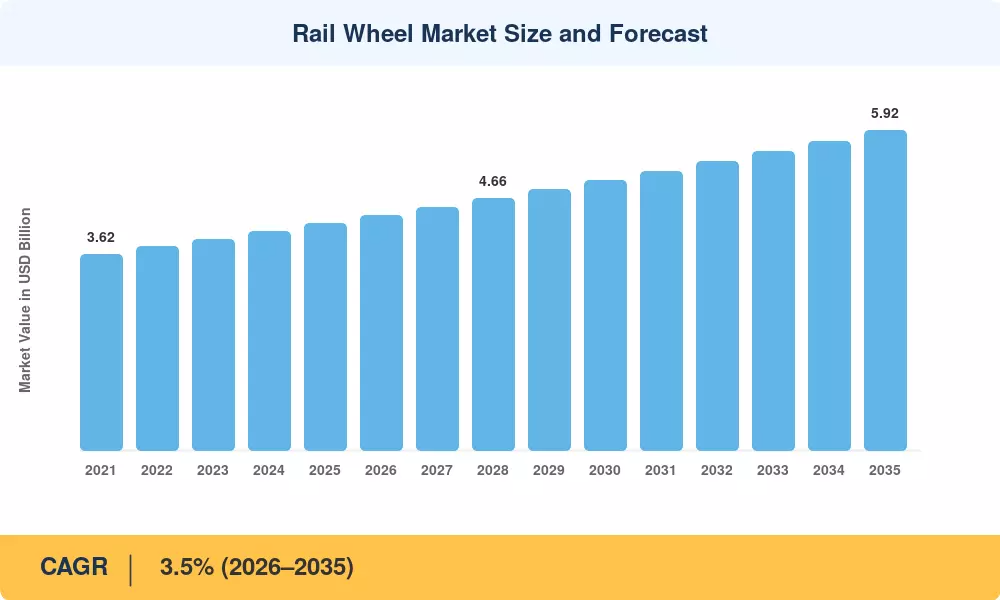
The global Rail Wheel Market stood at an estimated USD 4.20 billion in 2025 and is projected to reach USD 4.35 billion in 2026, climbing to USD 5.92 billion by 2035.”
NEW YORK, NY, UNITED STATES, July 21, 2026 /EINPresswire.com/ -- The global Rail Wheel Market stood at an estimated USD 4.20 billion in 2025 and is projected to reach USD 4.35 billion in 2026, climbing to USD 5.92 billion by 2035 at a compound annual growth rate of 3.5% during 2026–2035.— Arti Dhapte
Market Overview
Rail wheels are critical components of railway rolling stock, designed to support vehicle weight, provide traction, and ensure safe and stable movement along tracks. These wheels are manufactured using specialized steel grades and advanced forging or casting processes to withstand extreme loads, high speeds, and continuous wear from track interaction. The market encompasses various wheel types including forged steel monoblock, cast steel, resilient (rubber-insert), and tyred (shrink-fit) wheels, serving applications ranging from heavy-haul freight to high-speed passenger rail.
The market's steady growth is driven by several powerful catalysts. Governments in China, India, and the European Union have collectively committed more than USD 900 billion to rail infrastructure over the next decade, creating sustained demand for new wheelsets and replacement components. This expansion is coupled with increasing urbanization, growing demand for efficient public transportation, and the need to upgrade aging railway infrastructure globally. Additionally, the focus on decarbonization and the shift from road to rail transport are bolstering investments in railway networks and rolling stock.
The Rail Wheel Market is undergoing a material technology shift. Traditional cast-iron wheels are yielding ground to forged-steel monoblock designs that offer superior fatigue resistance and longer service intervals. European railways, for instance, now specify ER7 and ER8 grade steels for high-speed trainsets operating above 250 km/h, driving manufacturers to upgrade forging presses and heat-treatment lines. China's CRRC alone invested USD 280 million between 2022 and 2024 in wheel and axle production capacity to support its expanding high-speed network.
Technological developments are rapidly expanding the market's capabilities. Laser-cladding technology may restore worn wheel flanges to their original profiles for around 40% of the cost of a new wheel, opening up a new service-revenue stream. Embedding sensors into wheelsets and creating digital-twin models offer a data-monetization method, with operators buying into predictive analytics subscriptions. The development of specialized hollow-disc profiles and high-strength aluminum-composite hub systems for hydrogen-powered and battery-electric multiple units is addressing the stringent weight budgets of zero-emission regional rolling stock.
Policy and regulatory influence on the market is substantial and growing. The EU's revised TEN-T regulation mandates completion of nine core corridors by 2030, with 160 km/h minimum speeds that push operators toward premium wheel grades. The European Railway Agency's forthcoming eco-design regulation (expected 2028) may mandate minimum recycled-steel content in new wheels, giving an edge to producers with electric-arc-furnace capacity. In North America, the Federal Railroad Administration's safety and performance standards drive demand for high-integrity wheels designed to minimize risks of derailments and accidents.
The demand outlook remains positive, with the market's growth profile increasingly tilting toward premium wheel grades and aftermarket services. Asia-Pacific dominates the Rail Wheel Market with approximately 42% revenue share, powered by China's 45,000 km high-speed rail network and India's Vande Bharat program. Europe holds the second-largest share at roughly 28%, anchored by Deutsche Bahn and SNCF fleet renewals. North America, accounting for about 18% of the market, is the region with the heaviest freight-axle-load requirements — a dynamic that shapes distinct wheel metallurgy specifications.
📍 Get Free Sample Report for Detailed Market Insights:
https://www.marketresearchfuture.com/sample_request/32229
Market Segmentation
By Wheel Type
The market is segmented by wheel type into Forged Steel Monoblock, Cast Steel, Resilient (Rubber-Insert), and Tyred (Shrink-Fit) wheels. Forged-steel monoblock wheels command roughly 61% of the Rail Wheel Market by revenue, driven by their dominance in freight, intercity, and high-speed rolling stock . These wheels combine high fatigue strength with manufacturing scalability, with AAR Class C forged wheels sustaining 315 BHN hardness levels required for 32.5-ton axle loads . Resilient wheels — featuring rubber inserts between the tire and hub — are the fastest-growing segment at a CAGR of 4.8%, propelled by metro and light-rail expansion in emerging cities where transit authorities in noise-sensitive urban corridors mandate rubber-damped designs to meet community noise ordinances below 75 dB(A) . Cast-steel wheels account for approximately USD 780 million, serving legacy freight fleets in North America and CIS countries .
By Application
Application segmentation covers Freight Rail, Passenger – Intercity/Regional, High-Speed Rail, and Metro and Light Rail. Freight rail accounts for 46% of global Rail Wheel Market demand, reflecting heavy replacement cycles driven by high axle loads. A typical 100-car unit train uses 800 wheels, each with a service life of 5–8 years under heavy-haul conditions . Passenger – Intercity/Regional represents USD 0.92 billion in 2025, driven by fleet age and capacity additions. High-speed rail is expanding at a 5.1% CAGR within the Rail Wheel Market, led by procurement programs in China, Japan, and Spain, where wheels must meet exacting out-of-round tolerances below 0.1 mm . Metro and light rail account for 18% share, driven by urbanization and transit investment, with over 50 cities worldwide building or expanding metro systems .
By Sales Channel
Sales channel segmentation includes OEM (New Build) and Aftermarket (Replacement). The OEM channel currently accounts for the larger share at 62%, serving trainset manufacturing pipelines and new rail infrastructure projects. The aftermarket is gaining ground at a CAGR of 3.8% as installed fleets age and predictive-maintenance programs identify wheels for early replacement rather than scheduled overhaul. With the average age of European passenger-rail fleets at 22 years and nearly 35% of Deutsche Bahn's regional fleet beyond its design life in 2024 , aftermarket activities contribute around 38% of the total income of the Rail Wheel Market, providing resilience to capex slowdowns.
By Region
Regional segmentation includes North America, Europe, Asia Pacific, South America, and the Middle East and Africa. Asia-Pacific leads with a 42% share, while Europe's aftermarket segment contributes USD 1.05 billion annually. North America holds approximately 18% share. The Middle East & Africa is growing at a 3.9% CAGR, spurred by GCC rail megaprojects such as Etihad Rail and Saudi Arabia's Landbridge.
🛒 You can buy this market report at:
https://www.marketresearchfuture.com/checkout?currency=one_user-USD&report_id=32229
Regional Analysis
Asia-Pacific
Asia-Pacific dominates the Rail Wheel Market with approximately 42% revenue share, powered by China's 45,000 km high-speed rail network and India's Vande Bharat program. China remains the single largest country in the market with USD 1.05 billion, with CRRC supplying the vast majority of domestic demand. China's State Railway Group plans to extend the national high-speed network from 45,000 km to 70,000 km by 2035, requiring an estimated 12,000 new trainsets. India is the fastest-growing major market at a CAGR of 5.2%, with the Rae Bareli wheel plant ramping capacity to 100,000 wheels per year in 2024, reducing import dependency. Japan contributes USD 0.28 billion, driven by the Shinkansen replacement cycle. South Korea grows at a 3.1% CAGR, supported by KTX fleet modernization. Australia contributes USD 0.12 billion, driven by heavy-haul iron-ore railways.
Europe
Europe holds the second-largest share at roughly 28% of the global market, anchored by Deutsche Bahn and SNCF fleet renewals. Germany leads regional demand at 24% of European share, driven by Deutsche Bahn fleet renewal programs. The UK contributes USD 0.18 billion, with HS2 procurement and Midlands fleet upgrades. France grows at a 3.0% CAGR, supported by TGV-M next-generation trainsets. Italy grows at a 2.8% CAGR, driven by Trenitalia regional upgrades. The European Rail Wheel Market is shaped by stringent EN standards and a mature aftermarket. The EU's Fit for 55 package incentivizes modal shift from road to rail, indirectly bolstering wheel procurement budgets.
North America
North America accounts for about 18% of the market and is the region with the heaviest freight-axle-load requirements — a dynamic that shapes distinct wheel metallurgy specifications. The United States accounts for 82% of regional share, with Class I railroads operating at 35.75 short-ton axle loads and piloting 35-ton configurations that accelerate wheel wear and shorten replacement intervals from 300,000 miles to roughly 240,000 miles. Amsted Rail and Standard Steel supply more than 60% of Class I demand, with AAR specifications requiring distinct metallurgical profiles — Class C and D wheels rated for 36-inch diameters. Canada grows at a 3.0% CAGR, driven by grain and resource commodity corridors. Mexico contributes USD 0.05 billion, with Tren Maya and suburban rail driving demand.
Rest of the World
The Rest of the World segment, encompassing South America and the Middle East and Africa, presents developing market opportunities. Brazil anchors South American demand with 58% of regional share, driven by iron-ore and agribusiness rail freight, with Vale and MRS Logística operating heavy-haul networks that consume wheels at accelerated rates. Argentina grows at a 3.4% CAGR, driven by commuter-rail modernization. Saudi Arabia is the fastest-growing market in the Middle East and Africa at a CAGR of 4.5%, with the Public Investment Fund financing a rail network linking east and west coasts. The UAE contributes USD 0.04 billion, with Etihad Rail freight and passenger programs. South Africa accounts for 38% of regional share, driven by Transnet freight recapitalization.
Competitive Landscape / Key Players
The Rail Wheel Market exhibits moderate concentration, with the top five producers controlling roughly 48% of global revenue. Key companies operating in this market include CRRC Corporation, Interpipe, Lucchini RS / Jinxi Axle, Amsted Rail, Nippon Steel Corporation, Evraz, Sumitomo (Standard Steel), CAF (MiiRA), Kolowag, and Taiyuan Heavy Industry.
Strategic developments in the market include significant capacity expansions and product innovations. Lucchini RS / Jinxi Axle maintained active volume optimization across their specialized Chinese manufacturing joint venture in November 2024, standardizing shared technical workflows to manufacture high-velocity monolithic passenger wheelsets conforming to strict EN 13262 standards. Indian Railways announced a tender for 200,000 forged wheels over three years for the Vande Bharat program in January 2025, one of the largest single procurement actions in the market. Interpipe resumed full-capacity forging operations at its Dnipro facility in May 2024 after completing wartime damage repairs, restoring approximately 500,000 wheels per year of export capacity.
Competitive differentiation increasingly hinges on certification to international standards (EN 13262, AAR M-107/208), metallurgical expertise, aftermarket service networks, and digital monitoring capabilities. State-backed conglomerates like CRRC compete alongside specialized forging companies like Lucchini RS and diversified industrial groups like Nippon Steel. The market landscape blends companies with vertically integrated steel-to-wheel production with specialized wheel manufacturers focused on specific applications.
Latest Industry News & Developments
Recent industry developments highlight the ongoing transformation of the rail wheel market toward premium materials, sustainability, and digital services. Indian Railways announced a tender for 200,000 forged wheels over three years for the Vande Bharat program in January 2025, representing one of the largest single procurement actions in the market and reflecting the growing demand for high-speed rail components.
In May 2024, Interpipe resumed full-capacity forging operations at its Dnipro facility after completing wartime damage repairs, restoring approximately 500,000 wheels per year of export capacity. This development addresses supply chain concerns that emerged following disruptions in Ukrainian supply and helps stabilize global wheel availability.
The European Union Agency for Railways published draft eco-design guidelines for rail components in February 2025, including minimum recycled-content targets for new wheels effective 2028. This regulatory development signals a shift toward sustainability and circular-economy models in the Rail Wheel Market, favoring producers with electric-arc-furnace capacity.
Market Challenges & Opportunities
Key restraints facing the rail wheel market include steel and alloy raw-material price volatility, with wheel-grade steel seeing price swings of up to 28% between 2021 and 2023, squeezing manufacturer margins and delaying contract finalization. Long procurement and certification cycles, with a new wheel design requiring 18-30 months and costing USD 2–5 million per variant for EN 13262 or AAR M-107/208 certification, deter quick product iteration and pose challenges for new entrants. Competition from road and air freight moderates rail demand growth, particularly in North America and the Middle East. The shift to predictive maintenance extending wheel life through wayside wheel-profile measurement and onboard vibration analytics reduces replacement volumes, applying downward pressure on aftermarket revenues. Capacity constraints at specialty forging mills further limit supply.
Emerging opportunities in the market are substantial and diverse. Additive-repair and laser-cladding services present a significant opportunity, with laser-cladding technology restoring worn wheel flanges at around 40% of the cost of a new wheel, opening up a new service-revenue stream for wheel makers. Emerging-market metro systems in cities such as Lagos, Dhaka, Manila, and Bogotá represent greenfield metro demand totaling an estimated 4,500 trainsets by 2035, with manufacturers that establish local finishing or assembly partnerships capturing long-term aftermarket lock-in. Digital twin and condition-monitoring platforms offer data-monetization methods, with operators buying into predictive analytics subscriptions, shifting revenue profiles to recurring, SaaS-like sources.
Future potential lies in lightweight wheel designs for hydrogen and battery trains, addressing the stringent weight budgets of zero-emission regional rolling stock through specialized hollow-disc profiles and high-strength aluminum-composite hub systems. North American freight wheel premiumization, with Class I railroads exploring 35-ton axle loads, will accelerate demand for premium micro-alloyed and heat-treated wheels, with suppliers investing in bainitic-steel R&D commanding 20–30% price premiums over conventional carbon-steel products. The aftermarket is consolidating around platform providers that offer integrated wheel turning, ultrasonic testing, and predictive analytics as a bundled service, creating recurring revenue streams.
To explore more market insights, visit us at:
https://www.marketresearchfuture.com/reports/rail-wheel-market-32229
Final Market Summary
The rail wheel market is positioned for steady growth through 2035, driven by high-speed rail network expansion, urban metro buildout, freight axle-load upgrades, and sustained aftermarket demand. The projected valuation of USD 5.92 billion reflects sustained demand across freight, passenger, high-speed, and metro applications, with the market transitioning from traditional cast wheels to premium forged-steel monoblock and resilient designs.
The medium-term growth outlook remains positive, with the market registering a CAGR of 3.5% during the forecast period. Asia-Pacific will continue to lead market expansion through China's high-speed network extension and India's Vande Bharat program, while Europe and North America maintain significant positions through fleet renewal and heavy-haul freight demand. The ongoing development of additive-repair technologies, digital-twin platforms, and lightweight wheel designs will continue to expand market possibilities and applications.
Long-term industry potential extends beyond the current forecast horizon. Autonomous train operations and wheel-health intelligence, with Grade-of-Automation Level 4 metro systems requiring sensor-equipped wheels, will reshape supplier capabilities. The electrification supercycle, with global rail electrification expanding from 36% to 50% of track-km by 2035, will lift the value mix of the market through higher sustained speeds and regenerative braking loads. Sustainability and circular-economy models, including lifecycle carbon accounting and eco-design regulations mandating minimum recycled-steel content, will give an edge to producers with electric-arc-furnace capacity.
More Related Reports from MRFR Library:
Car Manufacturing Market: https://www.marketresearchfuture.com/reports/car-manufacturing-market-16168
Electric Vehicle Ev Charging Infrastructure Market: https://www.marketresearchfuture.com/reports/electric-vehicle-ev-charging-infrastructure-market-16207
Mobility Technology Market: https://www.marketresearchfuture.com/reports/mobility-technology-market-16211
Us Automotive Service Market: https://www.marketresearchfuture.com/reports/us-automotive-service-market-16248
Us Fleet Management Market: https://www.marketresearchfuture.com/reports/us-fleet-management-market-16431
Us Auto Parts Market: https://www.marketresearchfuture.com/reports/us-auto-parts-market-17207
Us Electric Vehicle Charging Infrastructure Market: https://www.marketresearchfuture.com/reports/us-electric-vehicle-charging-infrastructure-market-17222
Europe Shared Mobility Market: https://www.marketresearchfuture.com/reports/europe-shared-mobility-market-17789
Automotive E Axle Market: https://www.marketresearchfuture.com/reports/automotive-e-axle-market-17802
Us Tractor Market: https://www.marketresearchfuture.com/reports/us-tractor-market-17867
Larry Wilson
WantStats Research And Media Pvt. Ltd.
+ +1 855-661-4441
email us here
Visit us on social media:
LinkedIn
Facebook
YouTube
X
Legal Disclaimer:
EIN Presswire provides this news content "as is" without warranty of any kind. We do not accept any responsibility or liability for the accuracy, content, images, videos, licenses, completeness, legality, or reliability of the information contained in this article. If you have any complaints or copyright issues related to this article, kindly contact the author above.
